


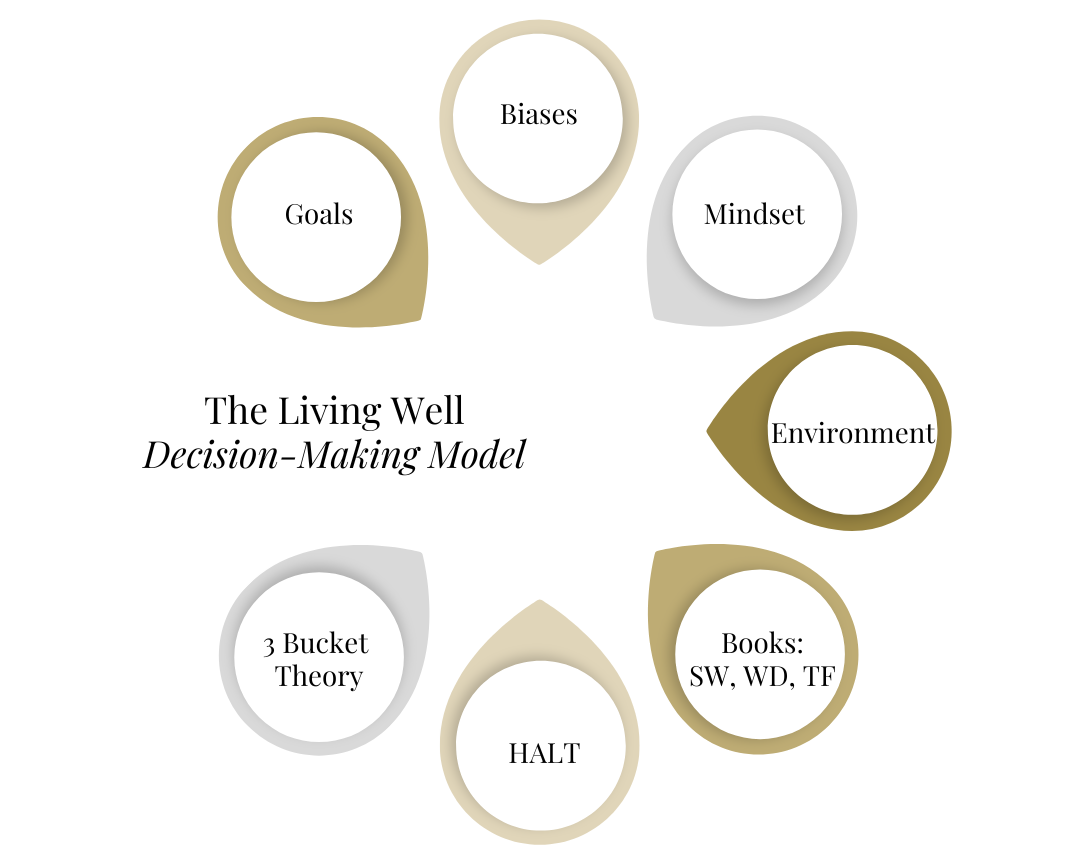
As you can see from the visual above, we have created what we like to call, the “Living Well Decision Making Model.” Let’s highlight a few key elements that shape our approach to financial planning, shall we?
Defining and Prioritizing Goals
At the heart of our process is the clear definition and prioritization of goals. As with many aspects of life, these goals serve as our "North Star." For short to mid-range goals (typically 1-3 years), we adhere to the “Jim Collins Method” from Good to Great, which emphasizes that having more than three priorities effectively means having none. This clarity helps us filter decisions—if a potential action moves a client closer to one of their top three goals, it’s a clear “yes.”
Understanding Biases in Decision Making
Biases can significantly impact decision making. One common bias we encounter is recency bias, where recent events are given undue weight. For instance, if the stock market dips just before a client meeting, clients often fear their accounts have suffered. However, a longer-term view frequently shows positive performance, countering immediate concerns.
In Thinking, Fast and Slow, Kahneman and Tversky discuss loss aversion, another prevalent bias. They found that losses feel twice as painful as equivalent gains feel good. For example, losing $20,000 in a $100,000 account feels twice as bad as gaining that amount. By discussing potential gains and losses with clients beforehand, we help them prepare for market volatility and reinforce the importance of staying the course.
Optimizing Mindset and Environment
A positive mindset and supportive environment are crucial for optimal decision making. As we discussed in a previous blog on the three-bucket theory, focusing on what we can control, influence, and recognizing what we cannot influence is vital. This approach helps clients manage their concerns and focus on actionable areas.
The HALT Principle
The acronym HALT—Hungry, Angry, Lonely, Tired—serves as a reminder to avoid making important decisions when not in the right state of mind. Ensuring that clients are alert and composed during decision-making moments is essential for sound financial planning.
Our insights to create "The Living Well Decision Making Model" are drawn from various influential books such as When, Winning Decisions, and Thinking, Fast and Slow. We hope these strategies enhance your decision-making process and you'll consider giving them a read!
If our Decision Making Model sounds like something that would align with your values, reach out! We’re here to support your financial journey, helping you make well-informed decisions to achieve your goals.